Blog
- Home
- Blog
How to Choose a Pipe Cutting Machine in 2026?
Choosing a Pipe Cutting Machine in 2026 is less about buying the newest model and more about matching equipment to the work you actually do. A workshop cutting stainless steel tube for handrails has different needs from a maintenance crew trimming large carbon-steel pipe on site. Pipe material, diameter, wall thickness, cut quality, and production volume all affect the decision. So does the workspace. A machine that fits neatly beside a fabrication bench may be impractical in a cramped service van.
Start with the cuts you make most often. Check the machine’s stated capacity against your pipe dimensions, and ask how it handles repeat cuts, bevels, and different materials. Look closely at blade or cutting-head costs, setup time, dust or chip control, and the availability of replacement parts. These details can matter more than a headline cutting speed. They add up.
Safety and operator experience deserve equal attention. Review guarding, emergency stops, workpiece support, and the manufacturer’s instructions before comparing prices. If possible, ask for a demonstration using material similar to your own. A clean showroom cut can look convincing, but real stock may be warped, coated, or inconsistent. That changes things. Even a careful shortlist has limits; no single machine suits every shop. This guide offers practical criteria for comparing options, while recognizing that workload, budget, and maintenance capacity will shape the final choice.
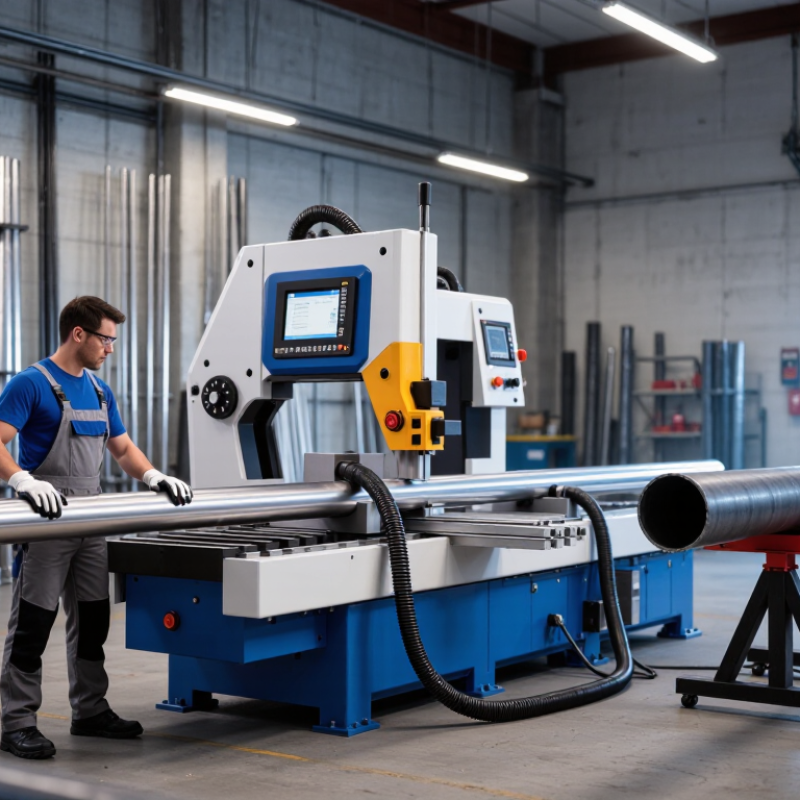
Identify Your Pipe Materials, Sizes, and Production Requirements
A pipe cutting machine should match the material on your workbench, not just a product description. Carbon steel, stainless steel, copper, aluminum, and plastic behave differently under a blade or abrasive wheel. Stainless steel may need controlled feed and cooling to limit heat marks. Thin-wall aluminum can deform if the pipe is clamped too tightly. Check both the material and its wall thickness.
Measure the full range of pipe diameters you expect to cut, including the smallest and largest sizes. Also record wall thickness, cut angle, and required length tolerance. A machine suited to thick steel may leave a rough edge on thin tubing. Ask for a sample cut using your actual pipe. Inspect the end for burrs, squareness, heat discoloration, and distortion. Small details matter.
Production needs change the choice. A few custom cuts per day call for easy adjustment and quick setup; repeated long runs may benefit from automatic feeding and consistent length control. Estimate cuts per shift, changeover frequency, and operator time—not just the machine’s advertised cutting speed. That number can mislead. Consider blade life, coolant use, dust or chip collection, and routine maintenance. I would not treat one specification as decisive; real pipe varies, and a trial cut may expose a mismatch you did not expect.
Compare Pipe Cutting Machine Types and Cutting Methods
How to Choose a Pipe Cutting Machine in 2026?
Compare Pipe Cutting Machine Types and Cutting Methods
Match the machine to the pipe material, diameter, wall thickness, and required end preparation. The U.S. Energy Information Administration’s 2023 overview describes a natural-gas pipeline network exceeding 3 million miles. That scale makes repeatable, joint-ready cuts important in maintenance and fabrication. Still, a high cutting speed alone does not guarantee a good fit-up.
Mechanical saws and cold-cutting machines suit many straight cuts and limit heat distortion, though blades need suitable support and upkeep. Abrasive saws are simple, but may leave burrs and a rougher edge. Plasma cuts conductive metals quickly, while oxyfuel is commonly used on thicker carbon steel. Laser cutting can deliver precise results, but pipe size, wall thickness, and machine cost may restrict its use. ISO 9013:2017 assesses thermal-cut quality using factors including dimensional tolerance, perpendicularity, and surface roughness. Consider all three—not just the kerf.
Tips: Cut a sample from the actual pipe, then check squareness, burrs, and bevel fit. A setup that works on thin tube may disappoint on thicker stock. I still allow time for adjustment; the first cut is not always the best one.
Evaluate Capacity, Accuracy, Speed, and Automation Features
When choosing a pipe cutting machine, start with the material and dimensions you actually run. Check maximum diameter, wall thickness, and supported pipe length against real jobs, not occasional best-case work. A machine rated for thick steel may struggle to hold thin-wall tube without deformation. Ask for a sample cut using your own material.
Accuracy depends on more than the machine’s stated tolerance. Look at cut-face squareness, burr formation, and repeatability across a full shift. Measure several finished pieces, including the first cut after setup. Speed matters too, but compare complete cycle time: loading, clamping, cutting, and unloading. A fast blade is less useful when operators wait between cycles.
Automation should match your workload and staff skills. Features such as automatic feeding, recipe storage, and cut-length checks can reduce repetitive handling, but they also add setup and maintenance needs. The International Federation of Robotics reported 541,302 industrial robot installations worldwide in 2023, reflecting broader growth in factory automation. A 2024 smart-manufacturing survey by Deloitte and MAPI found that 92% of manufacturers expected smart manufacturing to support competitiveness within three years. Those figures describe industry trends, not guaranteed savings from one machine. Check whether sensors catch misfeeds, and ask how long a changeover takes. I would not assume more automation is always better.
How to Choose a Pipe Cutting Machine in 2026? — Evaluate Capacity, Accuracy, Speed, and Automation Features
| Machine Type | Typical Capacity | Typical Cut Accuracy | Relative Speed | Automation Features | Best Suited For | Main Consideration |
|---|---|---|---|---|---|---|
| Manual band saw | Commonly handles round stock roughly 100–250 mm in diameter; capacity varies by machine and workpiece shape. | About ±0.5–1.0 mm under suitable conditions; blade condition, setup, and operator technique affect results. | Low; each cut generally requires manual positioning and operation. | Manual clamping and feed; basic length stops may be fitted. | Repair work, prototypes, small batches, and shops with varied cutting requirements. | Low purchase and setup complexity, but labor input and part-to-part consistency can limit output. |
| Semi-automatic band saw | Often available for round stock from about 150 mm to over 400 mm, depending on frame size. | About ±0.3–0.8 mm is a practical planning range; material, blade, and machine condition matter. | Medium; powered cutting and return reduce manual effort, while loading and indexing may remain manual. | Hydraulic or powered feed, automatic saw-frame return, and adjustable cutting controls are common. | General fabrication and recurring batches of medium- or large-diameter pipe. | Check the capacity chart for the actual workpiece shape and miter angle, not just the advertised maximum. |
| Automatic band saw | Capacity commonly spans roughly 150–500 mm or more across different machine sizes. | About ±0.2–0.5 mm can be achievable with a suitable setup and maintained tooling. | Medium to high for repeated straight cuts; actual output depends on material, wall thickness, and cut length. | Automatic feeding, length programming, clamping, and cycle control; some systems support bundle cutting. | High-volume production of repeat lengths, especially where versatility is important. | Confirm feed-length tolerance, remnant length, bundle capability, and changeover time. |
| Circular cold saw | Commonly used for smaller to medium tube and pipe sizes, often up to approximately 150–250 mm, depending on design. | About ±0.1–0.3 mm is a typical target for a properly set up saw and suitable material. | High on repeatable cuts; cycle time depends on diameter, wall thickness, material, and blade selection. | Manual, semi-automatic, and automatic versions are available; automatic models can include feeding and length control. | Clean, square cuts and repeat production in compatible metals and size ranges. | Blade cost and selection matter; verify that the cutting method suits the material and required edge finish. |
| Fiber laser tube cutting system | Common systems process tube or pipe with outside diameters from small sizes to roughly 200–350 mm; larger formats are available. | Often around ±0.1–0.3 mm for positioning or cut features under specified conditions; results depend on machine, material, and process settings. | High for complex profiles and many small features; advantage varies with geometry and setup time. | Typically includes CNC programming; options may include automatic loading, unloading, material measurement, and nesting. | Complex profiles, slots, holes, and frequent design changes in production. | Evaluate material and wall-thickness limits, gas requirements, fume extraction, software, and total operating cost. |
| Plasma tube cutting system | Capacity depends on torch and rotary axis; systems are commonly configured for medium to large tube and pipe. | Typically less precise than laser cutting, often around ±0.5–1.5 mm for cut features, depending on setup and process. | High for suitable material and profile work; cutting quality and speed depend on thickness and geometry. | CNC control and rotary-axis programming are common; loading automation varies by system. | Larger sections and applications where plasma’s cutting range and process economics fit the specification. | Account for kerf, heat-affected edges, consumables, ventilation, and any secondary finishing required. |
Selection note: Figures are indicative planning ranges, not guaranteed specifications. Confirm capacity, tolerances, and production rates with the machine supplier using your actual material grade, outside diameter, wall thickness, cut geometry, and required cut length.
Check Safety, Maintenance, and Total Cost of Ownership
A pipe cutting machine should be judged by how safely it handles the actual work, not just by its cutting speed. Check that guards cover the blade and that emergency stops are easy to reach from the operator’s position. Try loading a heavy pipe and clearing a cut piece; awkward lifting or slippery offcuts can create risks. Small details matter. Ask operators to test the controls with gloves on.
Maintenance affects both uptime and cut quality. Look for accessible blade mounts, clear lubrication points, and a practical way to remove metal chips. If routine cleaning requires dismantling several panels, it may be skipped during a busy shift. That adds up. Review the service schedule and price common wear parts before purchase. A simple maintenance log can reveal whether blade changes or alignment checks are disrupting production.
Compare total ownership costs over several years, including tooling, energy, training, servicing, and expected downtime. A lower purchase price may not stay lower if setup takes longer or replacement parts are difficult to source. Estimate costs using your pipe sizes, daily cut volume, and materials, then ask suppliers to explain their assumptions. Estimates are imperfect; actual wear depends on use and operator habits. Keep a contingency in the budget.
Match Machine Specifications to Your Workplace and Budget
Choosing a pipe cutting machine starts with the work your team actually handles, not the largest capacity on a specification sheet. Record the common pipe diameters, wall thicknesses, and materials used each week. Leave room for occasional larger jobs, but avoid paying for capacity that sits idle. A machine rated for thin stainless steel may struggle with thick-walled carbon steel. Check the manufacturer’s cutting range against real job samples. Test the fit. A clean cut matters, but so do repeatability, edge condition, and setup time.
Workplace conditions narrow the options. In a fixed shop, floor space, power supply, and extraction may matter more than portability. On site, weight, transport cases, and access to stable power can decide whether a machine is practical. Ask operators to assess clamping, guarding, adjustment, and cleanup; a feature that looks convenient in a brochure may slow a real shift. Duty cycle matters too. Frequent cuts can overheat equipment designed for occasional use.
Set a budget that includes blades or wheels, replacement parts, training, maintenance, and downtime—not just the purchase price. Request a demonstration using pipe similar to yours, and note how long setup and blade changes take. Compare service response times and parts availability. I would still leave some budget unassigned: wear rates are easy to underestimate, especially when workloads change. A modest machine may be the better fit, unless frequent beveling or tight tolerances demand more control.
How to Choose a Pipe Cutting Machine in 2026
Match machine capability to your workplace and budget. Compare representative purchase-price ranges in USD; actual prices vary with cutting capacity, automation, and configuration.
Use these broad planning estimates as a starting point. Confirm current local quotes, pipe diameter and wall-thickness limits, material compatibility, and required production rate before choosing.