Blog
- Home
- Blog
Best Solar Batteries in China for Global Buyers?
China has become a major source of Solar Batteries for residential, commercial, and utility projects worldwide. Its manufacturing depth supports competitive prices, broad product choices, and rapid technology upgrades. The International Energy Agency’s Global EV Outlook 2024 reports that China produced about three-quarters of global battery cells. That scale matters. It can shorten procurement timelines and expand access to lithium iron phosphate systems.
Yet the lowest quotation is rarely the best purchase. BloombergNEF’s 2024 Battery Price Survey placed average lithium-ion pack prices at 115 dollars per kilowatt-hour, showing strong cost pressure across the industry. However, pack pricing does not reveal installation quality, warranty strength, software performance, or shipping risk. A battery sitting in a humid warehouse tells a different story from one operating safely beside a family home.
This guide examines Chinese suppliers through practical buyer concerns, including usable capacity, cycle life, inverter compatibility, thermal management, and after-sales support. The IEA’s Batteries and Secure Energy Transitions report states that global energy storage capacity must expand sixfold by 2030. Demand is therefore growing quickly, but quality control must grow with it. Certifications such as IEC 62619, UN 38.3, and region-specific grid approvals deserve careful verification. Not every impressive datasheet reflects field performance. That is an uncomfortable point, but an important one.
The best choice depends on climate, load patterns, local regulations, and service capability. A coastal installation may need stronger corrosion protection. An off-grid project may value repairability over peak efficiency. This comparison aims to make those trade-offs visible, while acknowledging that no single Chinese battery suits every global buyer.
What Makes China a Leading Solar Battery Manufacturing Hub
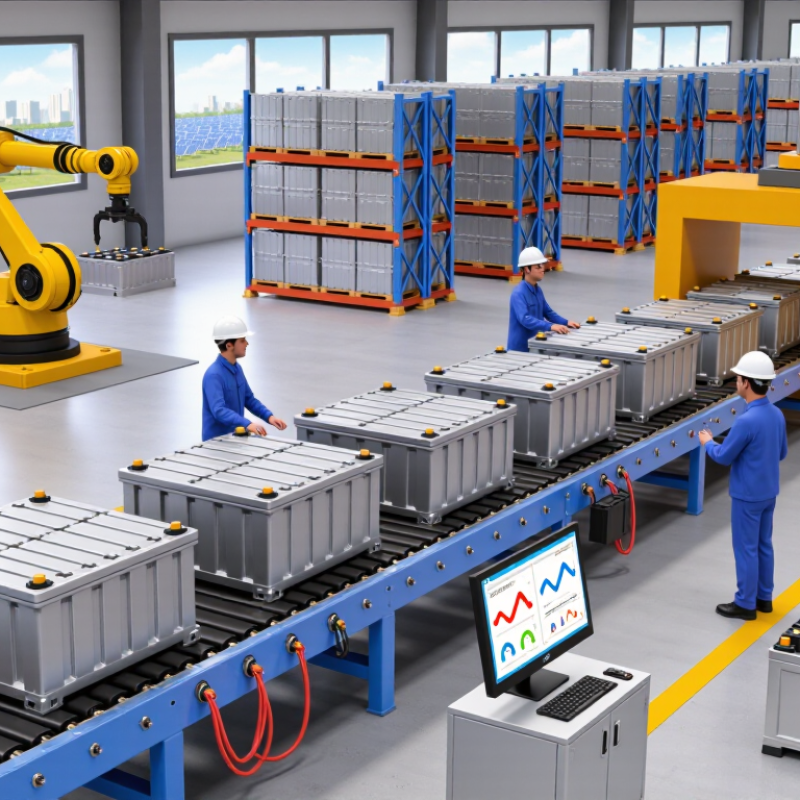
China has become a leading solar battery manufacturing hub through scale, dense supply chains, and fast engineering cycles. The International Energy Agency’s Global EV Outlook 2024 estimated that China produced about 80% of global battery cells in 2023. That industrial base also supports residential and commercial energy storage.
Manufacturers can source cathode materials, aluminum cases, battery-management systems, inverters, and testing equipment within short transport distances. This reduces coordination delays. It also lowers production costs. Wood Mackenzie’s 2024 energy storage analysis identified China as the world’s largest battery energy storage market, supported by strong domestic deployment and extensive manufacturing capacity. Factory production often benefits from automated cell assembly, thermal testing, and digital quality tracking. A typical inspection may examine weld strength, insulation resistance, temperature sensors, and cycle data before shipment.
Scale matters.
China’s solar manufacturing ecosystem adds another advantage. The IEA’s Renewables 2024 report stated that China held roughly 80% of global solar PV module manufacturing capacity. Shared suppliers and export infrastructure can shorten the path from battery production to overseas installation. Yet this strength should not be confused with guaranteed quality. A low quoted price may hide weaker monitoring, unclear degradation data, or limited after-sales support. Battery buyers should verify test reports, warranty conditions, safety certifications, and performance at high temperatures.
The supply chain is powerful, but not perfect. Smaller manufacturers may still struggle with consistent documentation and long-term service. That deserves scrutiny.
Types of Solar Batteries Available from Chinese Suppliers
Chinese suppliers offer several solar battery types for global buyers, each suited to different energy needs. Lithium iron phosphate batteries are widely selected for homes, shops, and small commercial systems. They provide stable output, strong cycle performance, and useful depth of discharge. Their built-in battery management systems can monitor temperature, voltage, and charging limits.
Some suppliers also provide nickel manganese cobalt batteries. These units can deliver high energy density in compact spaces. However, buyers should examine thermal controls and installation conditions carefully. Lead-acid batteries remain available, including AGM and gel models. They usually cost less at purchase, but they are heavier and often need shallower discharge. Their performance may decline faster in hot rooms or with poor charging habits.
Flow batteries appear in larger projects that value long operating cycles and separate power capacity from energy capacity. They can require more space and more complex installation. In practical sourcing, I would request test reports, cell specifications, warranty terms, and communication protocols before comparing prices. A low quotation can hide weaker components or limited after-sales support. It happens.
Buyers should also confirm compatibility with the inverter, local grid rules, shipping conditions, and required safety certifications. Ask whether cycle-life figures come from controlled laboratory tests or real operating data. Supplier documentation is useful, but it is not perfect evidence. Independent inspection and sample testing can reveal uneven cells, unclear labeling, or software limitations before a large order.
Key Specifications for Comparing Solar Batteries
For global buyers, solar battery specifications matter more than headline capacity. The IEA’s Batteries and Secure Energy Transitions report (2024) estimates that global battery storage capacity must expand from about 86 GW in 2023 to 1,200 GW by 2030. This scale increases the need for transparent testing and reliable documentation.
Start with usable capacity, not nominal capacity. A 10 kWh battery may deliver less after its recommended depth of discharge. Check round-trip efficiency, which NREL’s 2024 Annual Technology Baseline commonly models near 85–95% for lithium-ion systems. Chemistry also matters. Lithium iron phosphate cells generally offer strong thermal stability and long cycle potential, but performance still depends on temperature, charging limits, and installation quality. Look for cycle-life testing at stated conditions, not vague claims.
Check the continuous and peak power ratings separately. A battery may store enough energy but fail to start a pump or compressor. Confirm operating temperature, IP protection, communication protocols, warranty exclusions, and degradation limits. IEC 62619 and IEC 63056 are useful references for industrial and stationary lithium battery safety. Certification alone is not proof of lifetime performance. A spreadsheet can still mislead. I would request test reports, sample warranty cases, and independent inspection records before comparing quotations. Short warranty language deserves attention.
How to Evaluate Chinese Solar Battery Manufacturers
China remains a major battery manufacturing hub, but factory scale alone does not prove quality. The International Energy Agency reported that China held nearly 85% of global battery cell production capacity in 2023. BloombergNEF’s 2024 survey placed the average global battery-pack price at 115 US dollars per kWh. Lower prices can help buyers, but they may also conceal weaker testing, shorter warranties, or limited service support.
A serious evaluation should begin with the cell supplier, chemistry, and production traceability. Request independent test reports for capacity retention, thermal performance, and safety. Check whether results follow recognised IEC standards, rather than internal laboratory methods. Ask for operating data at high temperatures, especially if the system will work in tropical climates. Numbers need context. A quoted “6,000 cycles” means little without depth of discharge, temperature, and end-of-life capacity.
Review the manufacturer’s quality controls through factory audits, batch records, and failure-rate data. Confirm warranty exclusions, replacement procedures, spare-part locations, and remote monitoring responsibilities. The manufacturer should provide clear English documentation and realistic delivery schedules. I would also compare audited financial strength with export experience, not only product samples. One sample can look excellent. A spreadsheet can still mislead. The IEA’s Global Critical Minerals Outlook 2024 also highlights supply-chain concentration risks, so buyers should examine material sourcing and contingency plans. My own assessment would remain provisional until field references, independent certification, and after-sales response are verified.
Best Solar Batteries in China for Global Buyers? - How to Evaluate Chinese Solar Battery Manufacturers
| Evaluation Dimension | Practical Benchmark for Global Buyers | Evidence to Request from the Manufacturer | Suggested Weight | Buyer Evaluation Notes |
|---|---|---|---|---|
| Battery Chemistry | Lithium iron phosphate (LFP) is generally preferred for stationary solar storage because of its thermal stability and long cycle life. | Cell specification sheet, safety test reports, material declaration, and battery management system documentation. | 12% | Confirm whether the quoted capacity is usable energy or nominal energy. |
| Usable Energy Capacity | Residential systems commonly range from approximately 5 kWh to 30 kWh per installation; larger commercial systems are modular. | Rated capacity, minimum state of charge, maximum depth of discharge, and usable-energy test conditions. | 10% | Compare usable kWh rather than only the nameplate battery size. |
| Cycle-Life Performance | A competitive LFP product may quote around 5,000 to 8,000 cycles under defined laboratory conditions, often at 80% depth of discharge. | Cycle-test report stating temperature, charge and discharge rate, depth of discharge, end-of-life capacity, and test laboratory. | 12% | Do not compare cycle numbers unless the test conditions are equivalent. |
| Warranty Terms | A written warranty of 5 to 10 years is common for stationary storage, usually subject to energy-throughput or cycle limits. | Signed warranty, throughput limit, retained-capacity threshold, exclusions, replacement process, and claim-response time. | 14% | A longer warranty is not necessarily better if the throughput limit is restrictive. |
| Safety Compliance | The system should have documentation relevant to the destination market, including lithium-battery transport and stationary-battery safety requirements. | Applicable test reports or certificates such as UN 38.3, IEC 62619, IEC 63056, and regional electrical-safety approvals where required. | 16% | Check that certificates match the exact model, cell configuration, and factory entity. |
| Power Output | Residential battery systems often support approximately 3 kW to 10 kW continuous output, depending on module size and inverter configuration. | Continuous power, peak power duration, charge and discharge current, and output derating at high or low temperatures. | 8% | Ensure the battery can meet motor-starting loads and backup-load requirements. |
| Inverter Compatibility | Compatibility should be verified through a published communication protocol, approved inverter list, or completed integration test. | CAN or RS485 protocol map, firmware version, inverter compatibility list, and commissioning procedure. | 10% | Ask who is responsible if communication faults occur after installation. |
| Environmental Protection | Indoor and outdoor models should have a clearly stated enclosure rating; IP65 or higher is commonly requested for outdoor residential units. | Ingress-protection test report, operating-temperature range, humidity limits, corrosion protection, and installation manual. | 6% | Verify performance in the actual climate, especially hot, humid, coastal, or cold regions. |
| Manufacturing Quality Control | The supplier should operate traceable incoming-cell inspection, module testing, end-of-line testing, and serial-number control. | Quality certificates, production-flow chart, sample inspection records, cell traceability policy, and independent factory-audit report. | 8% | Prefer suppliers that can provide consistent records for every production batch. |
| After-Sales and Technical Support | A capable exporter should provide remote troubleshooting, spare-parts support, installation guidance, and a defined RMA process. | Support-service agreement, response-time commitment, troubleshooting manual, spare-parts list, and local service-partner information. | 8% | Evaluate total ownership cost, not only the initial purchase price. |
| Export and Logistics Readiness | The supplier should understand lithium-battery shipping requirements and provide compliant packaging and export documents. | UN 38.3 test summary, safety data sheet, packaging specification, dangerous-goods documentation, HS code, and agreed Incoterms. | 6% | Confirm whether the quoted price includes export packaging, documentation, insurance, and destination delivery. |
Global Buying, Certification, Shipping, and Installation Considerations
Buying solar batteries from China requires more than comparing capacity and price. Global buyers should request test reports, production dates, cell specifications, and clear warranty terms. Ask whether the battery meets IEC 62619, IEC 63056, or other standards required in the destination market. Certification depends on local rules. A certificate alone does not prove safe installation.
Shipping needs careful planning. Lithium batteries may require UN 38.3 testing, safety data sheets, dangerous-goods declarations, and approved packaging. Confirm the battery’s UN classification before booking sea or air freight. Check Incoterms, cargo insurance, customs documents, and port restrictions. One missing document can delay a container for weeks. Delivery schedules are estimates, not promises.
Installation should be reviewed before payment. The inverter must support the battery’s voltage range, communication protocol, and charging limits. A qualified local electrician should confirm permits, grid codes, fire spacing, and emergency isolation requirements. Outdoor systems may need protection from heat, moisture, and flooding. Ask for wiring diagrams and remote-monitoring instructions. Some suppliers provide excellent files, but others send incomplete manuals. That weakness should be addressed in writing. Request replacement procedures, spare parts availability, and warranty service contacts before the battery leaves the factory.